

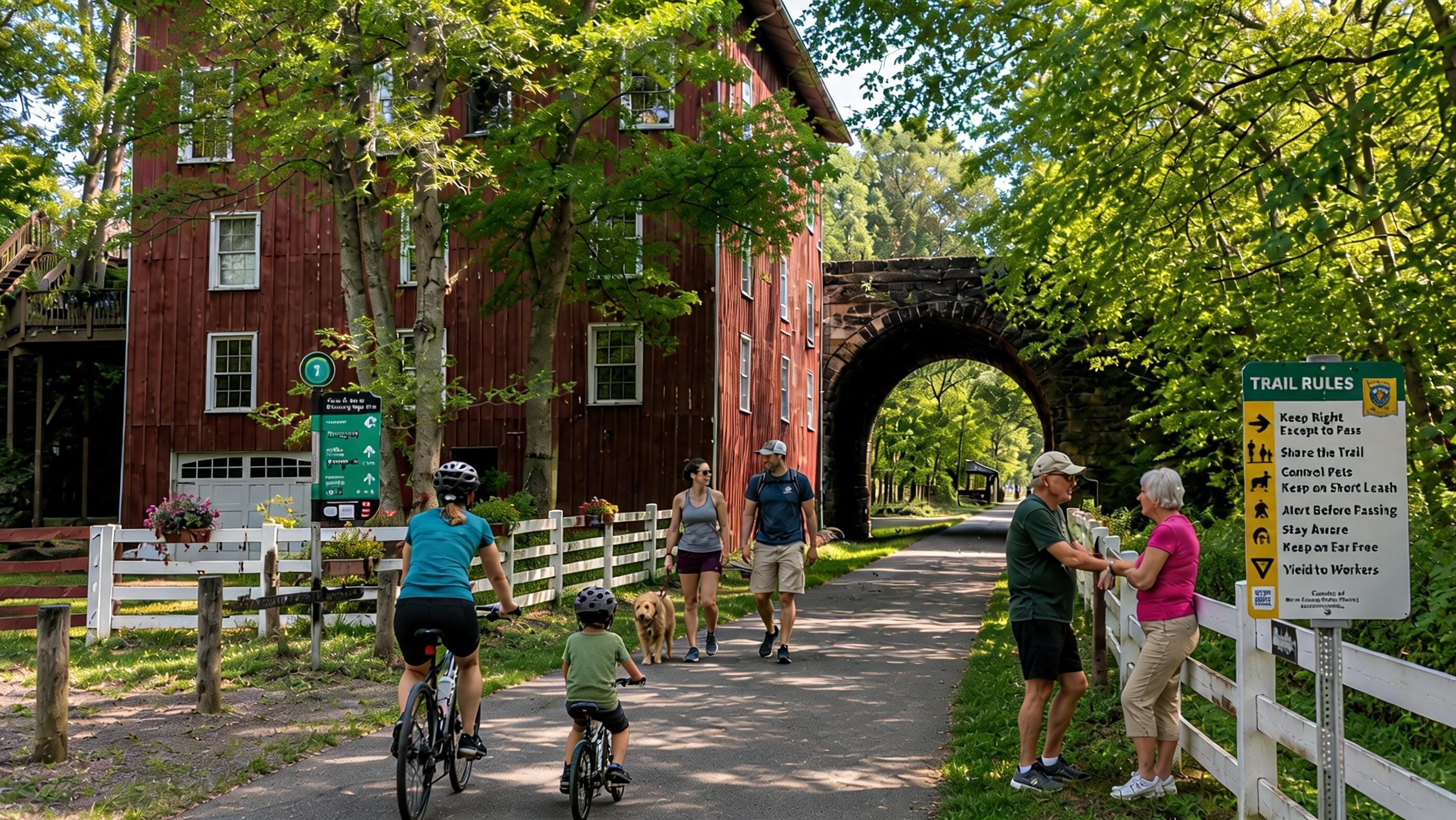
When communities debate budgets, trails and parks are often treated as “nice-to-have” amenities. They’re competing with other priorities and sometimes seen as recreational extras rather than essential public infrastructure.
Data from a national survey tells a very different story.
A survey commissioned by the Trust for Public Land and conducted by YouGov found that Americans overwhelmingly view parks, trails, and other outdoor public spaces as fundamental parts of healthy communities. Americans agreed by an 8-to-1 margin that local parks are part of their community’s essential infrastructure.
As someone who advocates for trails, I wasn’t surprised by these findings. What struck me was how overwhelmingly the numbers confirm what many of us have known for years. The impact of trails and parks extends well beyond recreation, contributing to healthier people, stronger economies, and more vibrant communities.
Healthy Communities
One of the strongest findings from the survey was the connection between outdoor spaces and personal well-being.
92% of Americans reported that improving their health motivated them to spend time outdoors in the past year. The most common reason people visited parks and trails was to be active. Walking, exercising, cycling, and participating in sports crossed all demographic groups and ages.
The benefits don’t stop with physical activity.
61% of respondents said they spend time outdoors to reduce stress and improve their mood. As anxiety, burnout, and social isolation become more common, parks and trails offer something screens cannot: places to get outside, stay active, and reconnect.
The survey also found that people who live within walking distance of a park are 35% more likely to meet recommended physical activity guidelines. That’s a remarkable return from a relatively simple community investment.
Building Community
The survey revealed another important role of parks and trails: they are desirable community gathering places.
More than half of Americans reported having a “third place” — a place other than home and work where people connect, build relationships, and enjoy community life. Parks and outdoor spaces ranked as the most popular of these gathering places.
Think about the life you see on a trail. Neighbors chat on morning walks, families ride bikes together, and others get lost in the outdoors. Trails create unexpected and new connections while strengthening existing ones.
At a time when many Americans of all ages are concerned about loneliness and social division, trails and parks create opportunities for casual human interaction that build stronger connected communities.
Green Time
One finding that stood out involved younger adults.
Many reported that putting down mobile phones, tablets, and video games was a major motivation for spending time outdoors. The desire for “green time, not screen time” was particularly strong among younger generations.
Anyone who has walked a shaded trail, listened to nature, or experienced sunrise or sunset on a trail understands why. Trails offer something rare in modern life: a chance to unplug from constant digital demands and reconnect with nature.
Strong Case
The health and quality-of-life benefits alone justify investment in trails and parks. But the economic case is even more compelling.
Analysis highlighted by Grist found that local parks generate roughly $3 in value for every $1 invested. That’s a return most communities would be thrilled to see from any public investment.
Returns show up in many ways. Property values tend to rise near trails. Outdoor tourism brings visitor spending to the town. Convenient access to places for exercise and mental renewal can lower health care costs.
Trails improve the quality of life, attract businesses, and help retain employees. Study after study shows that people want to live near a trail.
When communities invest in trails, they are not only building recreational amenities. They are creating infrastructure that supports public health, economic development, tourism, active transportation, and community vitality.
Americans Agree
Perhaps the most encouraging finding from the survey is that Americans understand this value.
Nearly nine out of ten adults agreed that communities should continue investing in affordable outdoor recreation so that everyone, regardless of income, can enjoy the benefits of parks, trails, and outdoor spaces.
That broad support crosses geographic, economic, and political boundaries because the benefits are widely shared. Trails don’t ask who you voted for. Parks don’t care about your income. Outdoor spaces belong to everyone.
Trails Matter
As a trail advocate, I often find myself explaining why a trail matters. The Trust for Public Land survey provides powerful evidence that the public already understands much of the answer.
Trails improve physical health. They support mental well-being. They strengthen social connections. They provide accessible recreation. They encourage active transportation. They boost local economies. They create places where communities come together.
Few public investments can claim such a wide range of benefits.
When communities invest in trails and parks, they aren’t spending money on amenities. They’re investing in healthier people, stronger neighborhoods, and vibrant local economies.
That’s not just good recreation policy. It’s good community building.
Beyond Pavement
If there is one lesson I hope elected officials, community leaders, and taxpayers take from this study, it is that public investments should be measured not only by what they cost, but by what they return.
In Ohio and across the nation, there’s a strong desire to reduce taxes and spend every public dollar wisely. That’s reasonable. When budgets are tight and competing priorities abound, decision-makers should ask this question: What investments deliver the greatest return for the people they serve?
Too often, that conversation focuses only on roads and highways. There is no question that cars are the primary means Americans travel and will always play a critical role in our transportation network.
As highways become more congested and harder to expand, communities should invest in transportation that improves the quality of life, supports local economies, and creates healthier places to live.
Trails Answer
The value of trails extends far beyond the pavement beneath our bike tires. Trails connect neighborhoods, support local businesses, improve public health, increase property values, attract visitors, and provide opportunities for recreation and transportation.
Trails are places where people exercise, gather with friends, experience nature, and reconnect with their communities. In many ways, they serve as the “third places” that strengthen the social fabric of our towns and cities.
Most people would choose an afternoon on a trail over sitting in traffic on a crowded highway. Trails offer something difficult to quantify but impossible to ignore: the opportunity to slow down, connect with the outdoors, and experience a higher quality of life.
Numbers Speak
According to the study, every public dollar invested in parks and outdoor recreation generates approximately three dollars in economic value, a 300% return. Few public investments can make a similar claim.
If you’re reading Tom on the Trails, chances are you already understand the value of trails. You’ve experienced firsthand how they improve communities, support local businesses, and enrich daily life.
I hope that these findings reach far beyond the outdoor recreation community and into the conversations taking place in city halls, county commissions, statehouses, and boardrooms across the country.
This study confirms something trail users have known for years.
Trails aren’t simply amenities. They’re infrastructure. They’re public health investments. They’re economic development tools. They’re community gathering places. And they make our towns and cities better places to live.
That’s a return worth investing in.
The Research
Trust for Public Land National Survey on Outdoor Public Spaces
https://www.tpl.org/parks-undeniable-roi-report
Grist article, “Your Local Park Is Bringing in the Green—and by That We Mean Money”
https://grist.org/cities/your-local-park-is-bringing-in-the-green-and-by-that-we-mean-money/
Excellent information, Tom. I’m sharing your story with my Facebook readers on This E-Bike Life.