

For most of the Ohio to Erie Trail’s thirty-five-year history, the focus has been on miles: building them, connecting them, and completing the trail. Today, 92% of its 326 miles are off-road and on trail, creating a premier long-distance outdoor experience for cyclists, hikers, and anyone drawn to exploring the outdoors.
Yet the trail is about more than the distance between two places. Its deeper appeal comes from the cities, towns, rural crossroads, farms, forests, rivers, canals, and country roads that together create a distinct experience of Ohio.
When distance and Midwestern culture come together, they create tourism rooted in outdoor recreation. As more people seek that experience, trail visitors become more frequent and visible. When visitors stop, explore, eat, shop, and stay overnight, the trail becomes an economic engine.
Communities, large and small, are seeing visitors who, before the trail, might have been unknown or driven past. What is emerging along the Ohio to Erie Trail is an invitation to pause, explore, eat, shop, stay awhile, and come back.
Discovering the Seed
In 1995, the Allegheny Trail Alliance, now the Great Allegheny Passage Conservancy, was connecting a continuous trail from Pittsburgh to Cumberland. As the trail grew, so did the communities around it. Restaurants, lodgings, bike shops, and outfitters emerged to serve visitors, creating a new outdoor tourism economy.
In 2011, I discovered bicycle touring with a friend. We embarked on a weeklong journey along the Great Allegheny Passage and the C&O Canal Towpath. It was on that trip that I was introduced to the Great Allegheny Passage Trail Town program.
The program was relatively young, but its impact was becoming evident. Towns along the trail were reinventing themselves. Communities once defined by the declining steel industries of the Pittsburgh region were finding new life and opportunities through the trail and the people it brought to their doorsteps.
That first trip inspired me to return. Over the years, I have become a frequent visitor to the Great Allegheny Passage. It has become a regular part of my touring calendar, sometimes a weekend retreat with my bike club, other times an end-to-end tour.
Each time I returned, I noticed something new.
The amenities and services along the trail grew as towns embraced the Trail Town mentality. More services attracted more visitors. More visitors created demand for even more services. That cycle created an experience increasingly attractive to visitors and residents alike.
I saw that a trail’s attractiveness and success wasn’t just the ribbon connecting one place to another. It was weaving itself into the identity and economy of the communities along its path.
Bringing the Seed Home
In 2018, when I joined the Ohio to Erie Trail board, the pieces of the 326-mile route were being increasingly connected. That connectiveness enticed more people to discover and explore the trail as tourists, just as I had discovered and experienced the Great Allegheny Passage.
As interest in the Ohio to Erie Trail grew, building the trail became only part of the work. Improving the visitor experience became just as important.
An interactive map and supporting trail guide became essential tools to help visitors navigate the trail more easily. The trail’s website shifted toward showing visitors where to stay, where to eat, what to see, and how to travel through trail communities.
As the leader of the volunteer marketing team, I saw that tourism was central to our role. We were not just building a connected cross-state trail. We were creating and promoting an outdoor destination. That distinction was becoming increasingly important.
Planting the Seed in Central Ohio
In early 2020, the marketing team planned a conference focused on outdoor recreation and tourism opportunities along the Ohio to Erie Trail. Our featured speaker was Amy Camp of Cycle Forward, an early leader of the Trail Town movement along the Great Allegheny Passage.
The pandemic changed everything, and the conference was canceled. Like many organizations, we pivoted to Zoom and hosted a series of webinars. Amy Camp was featured in two of our webinars, introducing the Trail Town concept.
Our goal was to help Ohioans see the trail’s potential beyond connecting miles to connecting communities and businesses to new opportunities.
The webinars were well attended and struck a chord with many participants. The Mid-Ohio Regional Planning Commission took particular interest in the opportunity to bring the concept to communities along the Ohio to Erie Trail in Columbus and the growing Central Ohio trail network.
In late 2021, the Ohio to Erie Trail partnered with the Rails-to-Trails Conservancy and the Mid-Ohio Regional Planning Commission to match a grant from The Columbus Foundation. This collaborative investment funded a multi-year effort to lay the groundwork for bringing Trail Towns to Central Ohio.
The seed had been planted.
Nurturing the Seed
By 2023, when I was elected president of the Ohio to Erie Trail board, more visitors were arriving, more trail miles were connected, and our website and resources were supporting a growing audience.
The board recognized the need to support outdoor recreation, tourism, and the local economy more intentionally. That meant expanding our mission beyond building and connecting trail miles to investing in the communities along the route.
In November 2023, the trail board defined a new strategic direction. The process challenged us to look not only at the miles still to be built, but also at what the trail could become.
The future of the Ohio to Erie Trail would not be defined solely by completing 326 continuous miles. It also needed to strengthen connections among communities, businesses, and residents to create a richer, more welcoming experience for trail users.
By improving the visitor experience and strengthening trail communities, we could help restaurants, lodging, bike shops, attractions, and other local businesses benefit from the people the trail brings into town.
In many ways, we were starting down the same path I had seen years earlier along the Great Allegheny Passage.
The Seed Takes Root
The seed planted in 2021 by the Rails-to-Trails Conservancy, Mid-Ohio Regional Planning Commission, and the Ohio to Erie Trail, with the support of the Columbus Foundation, began to grow.
Thanks to the leadership of Central Ohio Greenways staff within MORPC, the multi-year effort explored what a Trail Town could look like in Central Ohio, including how the concept might work in an urban environment and how wayfinding could improve the trail experience.
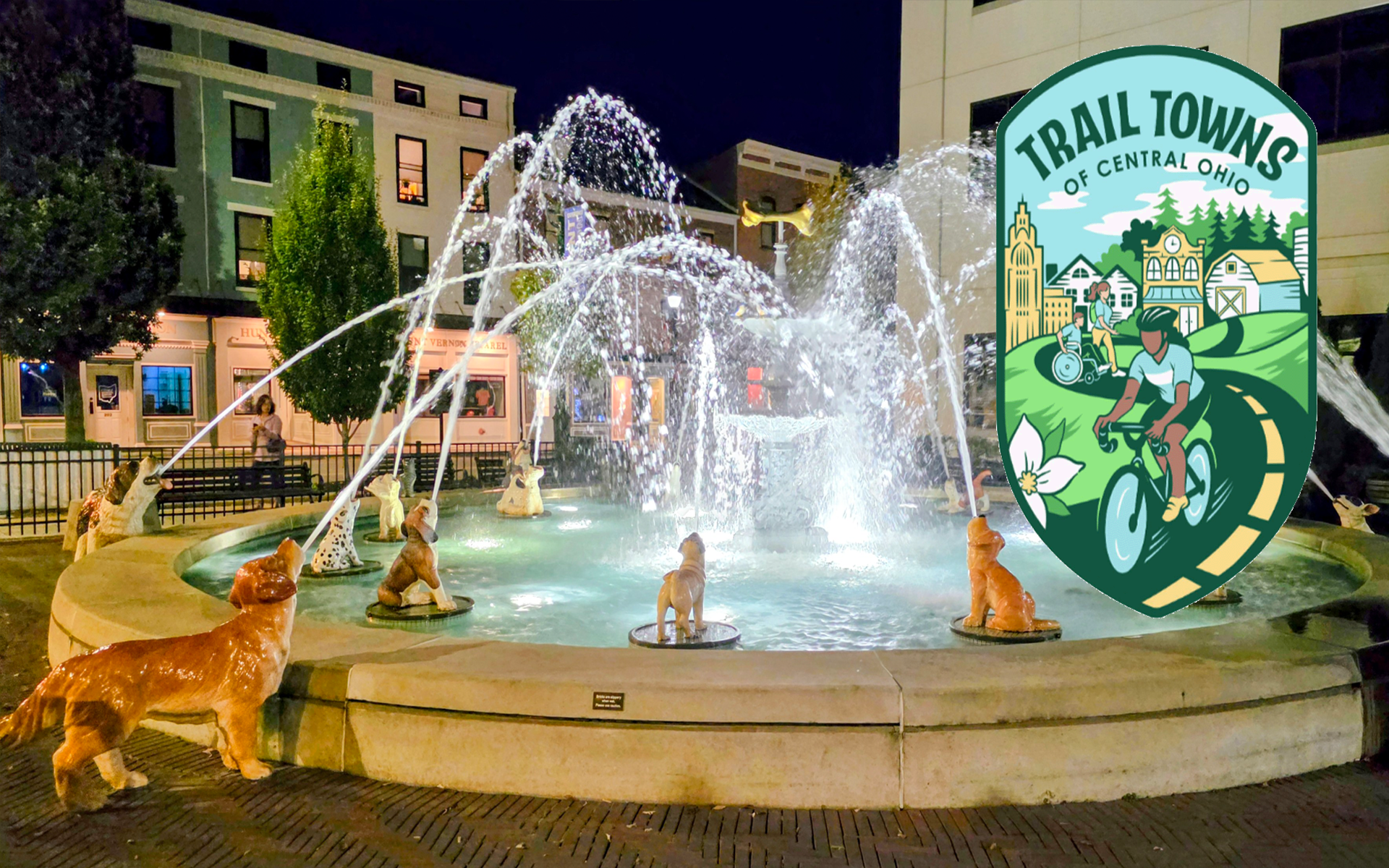
In late 2025, MORPC committed to a significant investment in Trail Towns. Communities along the Ohio to Erie Trail would become pilot communities, with London, Westerville, Centerburg, and Mount Vernon joining Worthington as Trail Town pioneers.
The Trail Town seed planted years earlier was sprouting.
The Seed Grows
What is happening in Central Ohio isn’t copying what worked along the Great Allegheny Passage. Trail Town initiatives can range from rigid programs to simple ideas. Here, each community is guided in finding its own way in defining what the trail means for its residents, businesses, and visitors.
As a participant in the Central Ohio Trail Town initiative, I have watched each town come together to create something it truly owns. That sense of community ownership matters.
For years, the Ohio to Erie Trail has been built through the work of the state, local governments, and trail groups, with investment focused mainly on completing and connecting trail miles.
This community-focused ownership shifts that model. The trail is the catalyst. Towns and businesses take the lead in building an outdoor recreation economy, visitor experience, and tourism identity they claim as their own.
That work is nearing completion, with a public reveal expected at the end of 2026. While the final details are still in progress, it has the potential to elevate the Ohio to Erie Trail to a new level.
The trail is proud to be part of this investment and grateful to the partners making it possible, especially the Mid-Ohio Regional Planning Commission. Their work has helped people in each community step forward and carry the Trail Town vision forward.
These communities recognize that the ideas that helped make the Great Allegheny Passage a premier outdoor destination can help Ohio’s trail communities and businesses thrive and strengthen the Ohio to Erie Trail.
What was planted as a seed planted in Pennsylvania now grows into something distinctly Ohio.
The Seed Grows Trail Town Reality
The most transformational part of the Central Ohio Trail Town initiative is its invitation to community members to collaborate in the work. A welcoming community is not created solely by trails and governments. It is shaped by the businesses and people whose actions tell visitors, “You are welcome here.”
What excites me most about the Central Ohio effort is that it is something uniquely Ohio. Not a cookie-cutter program. Not a rigid checklist that every community has to rigidly follow. Instead, it is a framework communities use to tell their own stories and create their version of a Trail Town.
If we get it right in Central Ohio, it could be the model for how Ohio leverages the concept along the entire Ohio to Erie Trail. The trail itself is only part of the experience. The real experience is the cross-state journey and the people, places, and communities discovered along the way.
That’s what makes a trail more than a trail. It becomes the connection of people to places.
That’s a seed worth planting, nurturing, and growing along the trail.
Thanks, Tom, for this story. The Ohio-to-Erie Trail has long been on my bucket list to visit. Your story motivates me to make it happen.