

Last week I wrote about one side of the e-bike discussion: behavior.
Most of the concerns people shared in my survey had less to do with the e-bike and more to do with how it was being ridden. Excessive speed, poor trail etiquette, inexperience, and a lack of courtesy came up again and again.
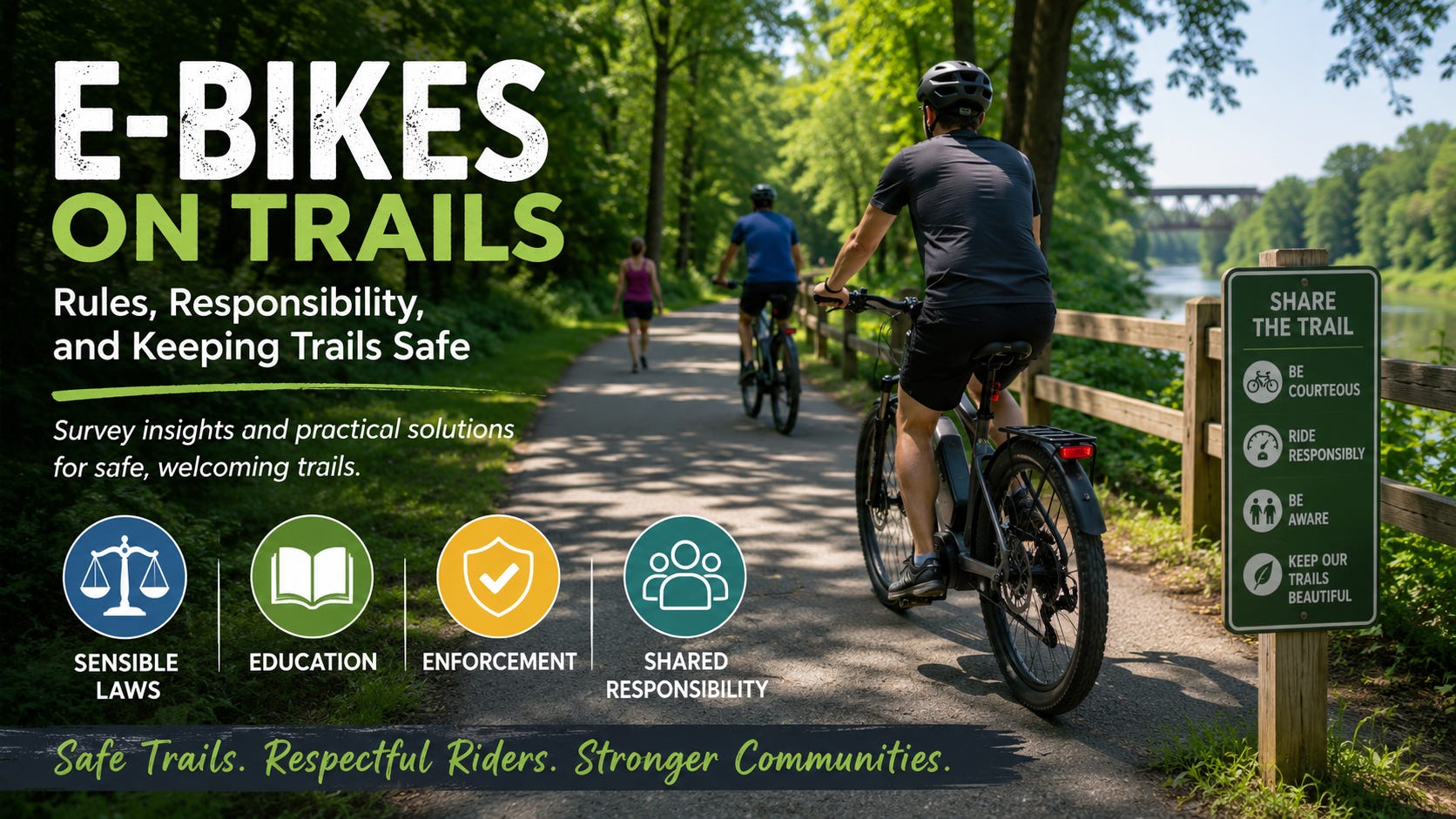
This week, I’d like to look at the other side of the issue: rules, regulations, education, and enforcement. How do we keep trails safe? Who should make the rules? Who enforces them? And how do we encourage people to ride responsibly while still welcoming e-bikes to our trails?
A Snapshot of the Survey
The survey has now received more than 250 responses, providing a good cross-section of trail users.
Nearly half of respondents ride traditional bicycles, about 30% primarily ride e-bikes, and roughly 20% ride both. That mix has produced a wide range of perspectives rather than one dominant viewpoint.
Most respondents ride for recreation and exercise (about 70%). More than half also identified assistance with aging or physical limitations as an important reason, reinforcing the value e-bikes provide to many people.
Not surprisingly, e-bikes are a common sight on trails. Nearly three-quarters of respondents frequently encounter them, while another quarter sees them occasionally.
When asked about their overall opinion of e-bikes on trails, the responses were more positive than negative. About 40% viewed them positively, another 20% somewhat positively, about 20% somewhat negatively, and roughly 15% remained neutral.
That tells me something important. This is not a debate about whether e-bikes belong on trails. It’s a conversation about how they are used.
Who Should Make the Rules?
One question asked who should be responsible for regulating e-bikes. Nearly half of the respondents believe the state government should establish the rules. Only a small percentage felt local governments alone should do so, while about a quarter favored a shared state-local approach.
That result mirrors what we’re seeing today. Because Ohio’s current laws don’t address many of the concerns riders identified, particularly unsafe behavior and excessive speed, many cities and communities have begun adopting their own regulations.
This creates confusing and, at times, inconsistent laws that are difficult to follow. Our growing connected network of trails allows cyclists to pass through numerous communities. An e-bike legal in one town may be prohibited in the next. For out-of-state visitors, it’s difficult to know which rules apply where.
Statewide standards create clarity. Local governments should still have flexibility to address unique situations, but the basic rules in a state should be consistent wherever someone rides.
Education Is the Missing Piece
One theme stood out prominently. People believe we need far more education.
Today, someone can walk into a bike shop, purchase an e-bike, and ride away with little or no instructions. The same is true for many bike-share systems, where you check out an e-bike and ride. No one explains cycling etiquette, e-bike basics, safe speeds, passing safely, or the different bike classes.
That gap creates predictable problems. Several ideas surfaced repeatedly throughout the survey:
Bike shops should provide basic education with every e-bike sale.
Trail organizations and local governments should regularly share safety tips and trail etiquette.
Community organizations, advocacy groups, and cycling clubs should offer introductory e-bike classes and clinics.
Short videos and social media campaigns could reinforce safe riding habits for both new and experienced riders.
Education is relatively inexpensive, easy to implement, and likely to have a much greater impact than simply adding more rules.
Enforcement Is Essential but Not Simple
Enforcement is an important part of the solution, but it’s also one of the most difficult pieces to get right.
Ohio already has laws governing e-bikes. The larger question is whether those laws address the issues trail users are actually experiencing. Survey respondents consistently identified unsafe speeds, poor trail etiquette, and irresponsible rider behavior, not the class of e-bike itself, as their primary concerns.
Even the best laws are only effective if they can be enforced. Most trails don’t have enough rangers or law enforcement officers to patrol the trail. With limited budgets and competing public safety priorities, trail enforcement falls low on the list. As a result, enforcement typically occurs after a crash or serious incident.
Laws that focus only on the punishment after an incident miss the opportunity to prevent the problem in the first place.
Improving enforcement requires more than passing new laws. It begins with educating legislators about the issues trail users are experiencing so they can craft laws that are practical, enforceable, and focused on prevention rather than reaction.
Enforcement requires resources. Enforcement needs funding to recruit, train, and deploy rangers or officers who can do more than issue citations. Their presence encourages safer riding and serves an equally important role by educating trail users, answering questions, and promoting responsible trail etiquette.
In the end, enforcement should be viewed as one part of a larger strategy, working alongside education, awareness, and shared responsibility to keep our trails safe and welcoming for everyone.
It’s a Community Responsibility
The survey’s clearest message about laws and rules is that trail safety is not solely the government’s responsibility. It is a shared responsibility that begins before anyone reaches the trail.
It starts with the person considering an e-bike. Buyers should research and understand the different e-bike classes, know where each is allowed, and choose a bike that fits how and where they plan to ride.
Bike shops play a critical role, too. They can help customers choose the right e-bike, explain its capabilities, review trail etiquette, and provide a basic overview of state laws, local regulations, and trail rules before the rider leaves the store.
Trail organizations, communities, advocacy groups, and the state can reinforce safe riding through social media, videos, signage, and public awareness campaigns. The Ohio Department of Transportation has already created useful e-bike resources that can be expanded to support this shared responsibility.
Ultimately, each cyclist is responsible for how they ride.
Knowing the rules is only the first step. Following them is what keeps trails safe and welcoming. Irresponsible riding has consequences that extend far beyond a possible citation. It influences whether families feel comfortable bringing their children to the trail and whether walkers, runners, birdwatchers, and cyclists alike continue to see our trails as places where everyone belongs.
The Biggest Takeaway
After reviewing hundreds of survey responses, one point is clear: most people believe e-bikes belong on our trails.
They value the independence e-bikes provide, for commuting, errands, recreation, exercise, and helping people ride who might otherwise be unable to. They also recognize that e-bikes make cycling more accessible and help more people stay active.
At the same time, respondents consistently noted that irresponsible riding can quickly change the feel of a trail. Excessive speed, poor etiquette, and unsafe behavior can make welcoming places feel less comfortable for everyone.
Put simply, the issue is not just about laws or enforcement. When education, enforcement, and personal responsibility work together, trails remain safe, welcoming places for all.
Next week, I’ll close the survey, publish the final results, and share the responses for anyone interested in exploring the data. I’ll also offer recommendations for a practical, balanced approach to managing e-bikes on our trails.
I hope you’ll join me for the final installment.
Happy trails,
Tom on the Trails
You are right that it has to be a state (Federal) standard otherwise interconnected trails have an issue. Can you imaging the chaos driving a car would be if each community had their separate rules? Also, onerous or confusing rules will prohibit tourism. For example, NJ's new rules would make me never visit NJ to ride their trails. I am VERY happy you will share the raw data. This I think is exceedingly important for the trail authorities to help determine the right policy. This is a great series!!!