

As election season winds down and lawmakers prepare to return to their statehouses, the debate over e-bikes on streets and trails continues to gain attention. Communities are adopting local rules, and state legislators are considering how to respond.
With proposals emerging across Ohio and neighboring states, now is a good time to examine what’s on the table and what these changes could mean for riders and other trail users.
In this edition of Tom on the Trail, let’s step back from the election headlines and take a broader regional look. Are our neighbors grappling with the same challenges as Ohio? Where do their approaches align, and where do they differ? Is there common ground in how we regulate e-bikes?
A Broader View
I’ve been following e-bike legislation in Ohio and neighboring states. What stands out isn’t any single bill, but the common themes emerging across the region. Together, these proposals may offer an early glimpse of a broader national approach to defining, regulating, and accommodating e-bikes.
How do we keep trails safe without discouraging people from riding? What rules make sense for different types of electric bicycles? How do we make those rules clear enough that someone traveling hundreds of miles doesn’t have to navigate a different set of laws at every turn?
These questions reach everyone who uses our trails, whether on an e-bike, a traditional bicycle, or on foot.
A Note on Scope and Terminology
The legislative summaries below describe proposals, not laws currently in effect, as of October 31, 2026. The Indiana and Kentucky sections provide context on existing laws rather than pending proposals. Links to official legislative pages and additional coverage are included where available. Consult the appropriate legislature’s website for the latest updates.
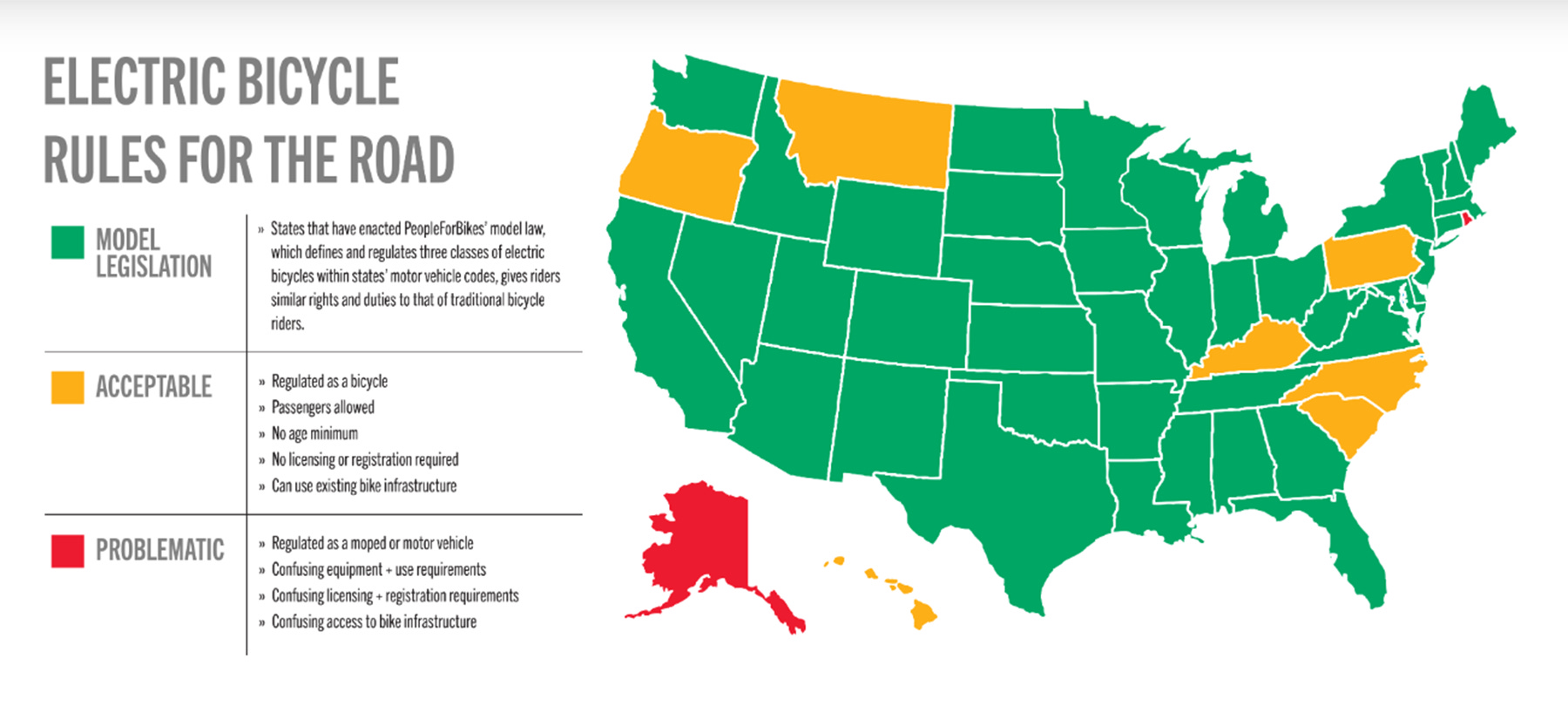
Forty-one states have adopted the three-class e-bike model promoted by People For Bikes. Eight states, including Kentucky and Pennsylvania, have regulations that People For Bikes considers acceptable. Learn more about e-bike classifications at People For Bikes.
Throughout this article, “e-bike” refers to an electric bicycle with fully operable pedals that fits within the three-class e-bike framework. “Other motorized devices” refers to vehicles outside those classes, including electric mopeds and motorcycles that are sometimes mistaken for e-bikes. Legal definitions and requirements vary by state.
What’s Happening in Ohio?
Ohio House Bill 948 expands bicycle-safety education and requires a review of existing laws. It establishes a statewide public-awareness campaign, adds safe-sharing practices to driver education and licensing exams, and requires online and in-person e-bike retailers to provide state-created educational materials.
The bill directs the Department of Public Safety to review vehicle classifications, gaps in current laws, and potential safety or training requirements for Class 3 e-bikes, off-highway motorcycles, and minibikes, including questions about local governments’ authority.
Ohio Senate Bill 477 focuses on safety and consistent statewide rules for e-bikes, e-scooters, and related mobility devices. It establishes minimum age and helmet requirements, requires a one-time $25 registration for devices used on public roads, creates a safety-education course, and sets speed limits on shared-use paths and sidewalks.
The proposal aims to protect riders and pedestrians while clarifying rules across communities.
What’s Happening in Pennsylvania?
Pennsylvania House Bill 2703 establishes a three-class e-bike system, allows state and local authorities to restrict e-bike use on certain roads and sidewalks, and prohibits mandatory registration, insurance, or licensing. It increases traffic-violation fines from $10 to $50 and imposes $100–$250 fines for careless operation causing bodily injury.
Pennsylvania Senate Resolution 322 directs the Joint State Government Commission to study e-bike laws and recommend potential changes. The study examines rider and pedestrian safety, bicycle infrastructure, and possible permitting requirements based on the capabilities and risks of newer e-bikes.
What’s Happening in Michigan?
Michigan House Bill 6339 requires e-bike batteries and electrical systems to meet recognized safety standards addressing lithium-ion batteries and electrical and fire hazards.
These requirements apply to batteries sold, e-bikes sold or distributed, and e-bikes operated by riders. Penalties could include fines of up to $1,000 for a seller’s first violation and $500 for riders, with higher fines for repeat seller violations.
Michigan House Bill 6340 distinguishes higher-powered electric mopeds and motorcycles from e-bikes. Throttle-operated vehicles exceeding 750 watts are classified as mopeds if they cannot exceed 30 mph and as motorcycles if they can exceed that speed.
Prohibits electric mopeds and motorcycles on nonmotorized natural-surface trails. The bill raises the minimum age for Class 2 e-bike riders to 14 and requires helmets for riders and passengers under 18 on Class 2 and Class 3 e-bikes.
Michigan Senate Bill 1156 prohibits children under 14 from riding e-bikes on public roads, sidewalks, or trails. Riders ages 14–17 need to wear helmets and have parental permission or supervision.
Violations could result in mandatory safety education for a first offense, followed by fines of up to $100 and possible e-bike impoundment for repeat offenses. Parents or guardians who knowingly allow violations could face fines of up to $250.
What’s Happening in West Virginia?
West Virginia Senate Bill 487 establishes a statewide Trail Authority to oversee trail development, access, maintenance, safety, and funding. Under the proposal, Class 1 and Class 2 e-bikes are generally allowed on designated state bicycle and shared-use trails unless trail-specific management plans impose restrictions. Class 3 e-bikes are treated as motorized vehicles and generally excluded from nonmotorized trails, with certain exceptions.
What’s Happening in Indiana?
I was unable to find any pending e-bike legislation in Indiana. Indiana adopted the People For Bikes three-class e-bike model in 2019.
No license, registration, or motor-vehicle insurance is required. Class 3 riders must be at least 15, and Class 3 operators and passengers under 18 must wear helmets. Trail access varies by class, and local restrictions may apply.
What’s Happening in Kentucky?
Kentucky has not adopted the People For Bikes three-class e-bike model and has no statewide legislation defining and regulating electric bicycles. Instead, e-bikes fall under existing bicycle laws, provided they meet the state's definition of a bicycle. This leaves classification, operating restrictions, and trail access without the consistency found in states that have adopted specific e-bike legislation.
What’s Happening in Congress?
The Safe SPEEDS Act (H.R. 7839) establishes national e-bike classification and labeling standards, prohibits marketing noncompliant devices as low-speed e-bikes, and improves crash reporting and safety education.
The SAFE Ride Act (H.R. 5265) provides federal grants to states for e-bike safety programs covering helmet use, rider education, crash reporting, shared e-bike safety, and enforcement, particularly involving minors.
It also calls for national helmet-safety recommendations for riders under 18. The bill doesn’t establish a national e-bike classification system or uniform trail-access rules.
Five Emerging Regional Themes
1. Safety
Safety is the common thread running through these proposals. Lawmakers are responding to concerns about excess speed, unsafe behavior, pedestrian safety, and the growing variety of other motorized devices.
On shared-use trails, people travel at different speeds and bring different levels of experience. Safe passing, appropriate speeds, and a shared understanding of trail etiquette need to be part of the conversation, not simply whether a bicycle has a motor.
2. Clear Definitions
A clear and consistent understanding of what qualifies as an e-bike is prominent across states. Under the three-class model, Class 1 e-bikes provide pedal assistance up to 20 mph; Class 2 e-bikes can provide throttle-powered assistance up to 20 mph; and Class 3 e-bikes provide pedal assistance up to 28 mph. All three must have operable pedals and meet the applicable motor and speed limits.
Devices outside those classifications should not be casually grouped with e-bikes. Higher-powered electric mopeds and motorcycles raise different regulatory and trail-access questions.
Legislation needs to make these distinctions clear so riders understand what they are purchasing, what they are riding, and where they can legally ride. Trail managers and law enforcement need to communicate those distinctions and apply the rules consistently.
3. Consistent Rules
Local communities are responding to concerns on streets and trails, particularly those involving young riders. These local responses create a patchwork of laws that vary from one community to the next.
State legislatures are beginning to address many of the same issues, while proposals in Congress could provide a common foundation for some aspects of e-bike safety and regulation.
Greater consistency helps riders understand their responsibilities, especially on routes that cross multiple jurisdictions. The challenge is achieving that consistency while preserving local communities’ ability to address their specific needs and conditions.
4. Access and Inclusion
E-bikes have opened cycling to people who might otherwise ride less often or not at all. They help older adults manage hills, allow riders with different fitness levels to travel together, and make longer trips possible for more people. Adaptive mobility devices can also be essential to trail access.
Age restrictions, registration requirements, helmet rules, and speed limits have merit when they address legitimate safety concerns. Regulations must target the behaviors and equipment creating problems, not penalize responsible e-bike riders or restrict access for those who rely on electric assistance.
5. Education and Enforcement
Rules are only effective when people understand them. Riders need clear, accessible information before they reach the road or trail. Trail managers and law enforcement need guidance and resources to explain the rules and respond to unsafe behavior.
Bike shops, online retailers, tourism partners, local governments, trail organizations, and community groups all have a role. Their perspectives can shape not only the legislation but also how new requirements are communicated and enforced.
Well-intentioned laws that are difficult to enforce or poorly understood can fall short of protecting the people they are meant to serve. Riders need to understand both the rules and the consequences of ignoring them for themselves and for others.
What Does This Mean for the Ohio to Erie Trail?
The Ohio to Erie Trail has an opportunity to shape this conversation constructively. Our responsibility isn’t to write Ohio’s traffic laws or determine the rules for the trail. Those responsibilities belong to lawmakers, public agencies, and the authorities managing individual trail segments.
We bring the experiences of trail users and communities into the discussion. That means monitoring proposals, understanding what their language means in practice, and sharing reliable information with our partners. It means listening to traditional cyclists, e-bike riders, walkers, families, older adults, people with disabilities, and businesses.
We can use this opportunity to review our visitor resources and ask practical questions now, before any new requirements take effect.
Are our explanations of e-bike classes clear?
Can visitors readily find information about local rules?
Do we clearly explain appropriate trail behavior?
Are we reaching the different kinds of people who use the trail?
We should be prepared to help lawmakers understand the Ohio to Erie Trail’s economic and tourism value, particularly its appeal to out-of-state visitors. Well-crafted, evidence-based regulations that promote safety and preserve a welcoming trail environment are important.
Poorly designed legislation could have unintended consequences, discouraging visitors and undermining the economic benefits the trail brings to the state and communities along its route.
Our route crosses communities and landscapes with very different conditions. What works on one section may require a different approach on another. The people who use and manage these segments can help explain those differences and inform better policy.
Where Do We Go from Here?
For now, the task is to watch the legislation, distinguish proposals from enacted laws, and contribute useful information.
Keep in mind that many of these bills have only recently been introduced, while others have been referred to committees that may not have met during the recent legislative recess. As legislators return, the language and direction of these bills may change.
As they move forward, we need to understand their final provisions and potential impact on shared-use trails. By working with local partners, we can keep information current and communicate changes clearly, helping people understand and follow the rules rather than leaving them to guess.
E-bikes have helped more people enjoy cycling and our trails. At the same time, every trail user deserves consideration, and everyone who rides has a responsibility to do so safely. We don’t have to choose between safer trails and welcoming trails. The work is finding a practical balance.
Looking at the broader regional picture, I believe that’s the conversation worth having, not just how to restrict a new technology or avoid rules altogether, but how to make our trails safer, more accessible, and more enjoyable for everyone.
Happy Trails!
Tom on the Trail