

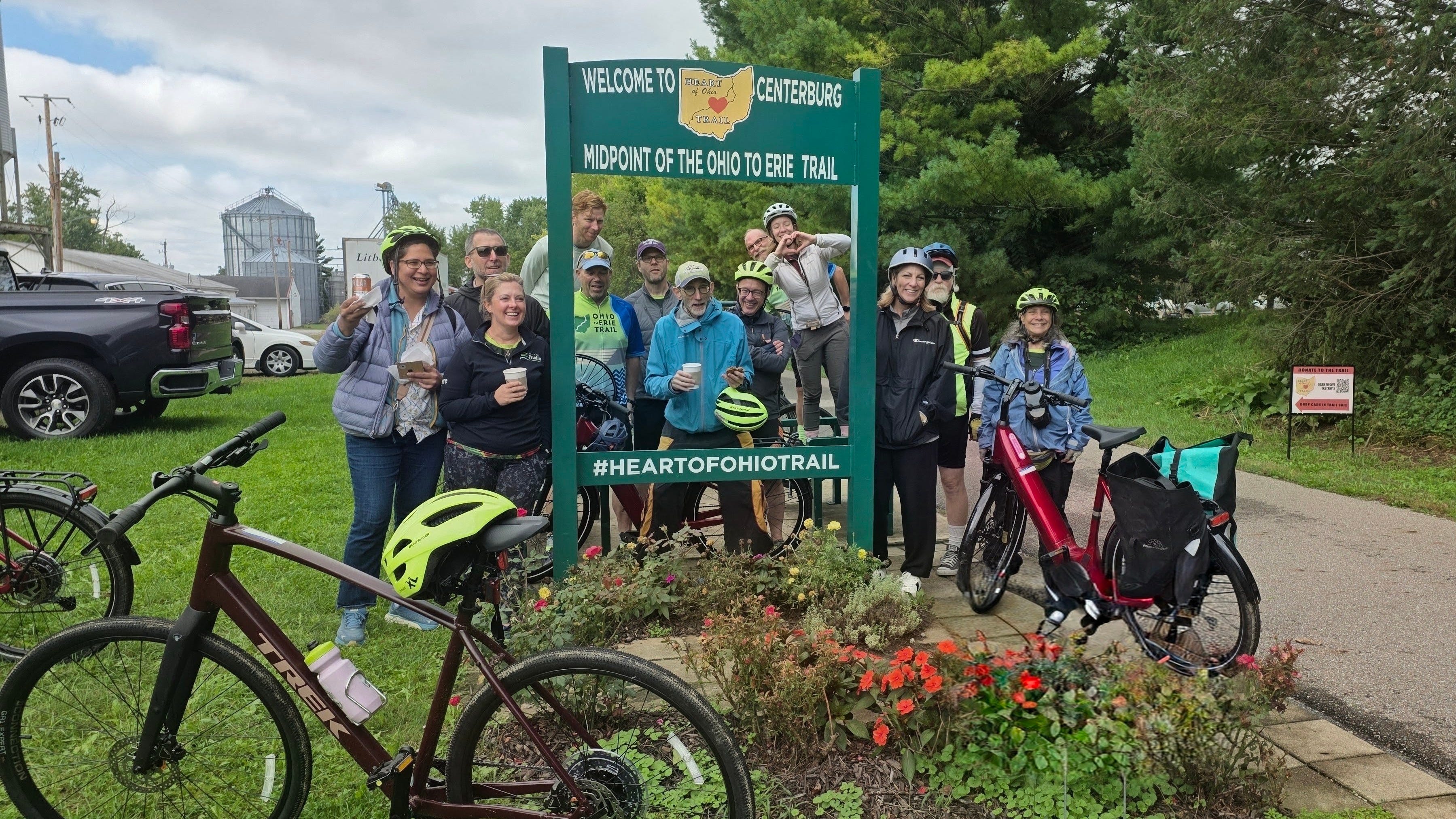
Over the past two weeks, I’ve had the chance to see Ohio through the eyes of people experiencing it for the first time.
First, I spent seven days cycling the Ohio to Erie Trail with a group of 16 fellow cyclists. A few days later, I joined a group of outdoor influencers for two days on the trail as part of a Rails-to-Trails Conservancy Great American Rail Trail influencer tour.
The groups and the rides were very different, but from behind the handlebars I noticed the same thread running through both.
Many had never visited Ohio. Others had been here but had never experienced the state from its trails. They came from the West, the South and the Northeast, and some from Ohio itself. Each brought personal experiences, regional perspectives and ideas about what Ohio would be like.
They climbed onto their bikes and started pedaling. In conversations on and off the trail, I kept hearing versions of “Wow! These days have really challenged my view of Ohio.“
Those comments warmed my heart as the leader of the Ohio to Erie Trail. They affirmed that this trail and this state offer something distinctive enough to surprise people.
Visitors Helped Me See Ohio
Maybe their reactions shouldn’t have surprised me. I’ve spent most of my life in Ohio, traveling and living across the state. I’ve cycled its roads and trails, hiked its parks and walked my dogs along its paths. I know there is more here than cornfields and soybeans.
When cyclists arrived with one set of expectations and discovered something different, I paid attention. After years of promoting the Ohio to Erie Trail, their reactions meant a lot to me. They also pointed to something bigger.
We often see places through the lens of what we’ve been told about them rather than through our own experience.
Visitors arrive without that familiarity, carrying either a blank slate or familiar stereotypes. Maybe it’s time to replace those assumptions with a new view of Ohio, not glimpsed from a red-eye between New York and Los Angeles, but experienced up close from a bicycle.
Three Cities, Three Stories
One of the things that makes the Ohio to Erie Trail unique is that it connects Ohio’s three largest cities: Cincinnati, Columbus and Cleveland. Each tells a different story.
Cincinnati’s history and culture are deeply influenced by its location on the Ohio River and its German heritage. Columbus is the state capital, a growing and increasingly diverse urban center. Cleveland carries the imprint of Lake Erie, generations of European immigration and a powerful industrial past.
All three reflect Ohio, but none is a copy of the others. Each has its own personality, neighborhoods and stories. The Ohio to Erie Trail links them and, in doing so, tells a larger story about the state.
Think about that. You can dip your back tire in the Ohio River, ride through the state’s three largest cities, pass farms and small towns, and eventually touch your front tire to the shore of Lake Erie. Not many trail systems can do the same.
This is Ohio, where cities, towns, farms, parks, and people are connected by a trail that reveals the state one mile at a time.
Towns Missed on the Interstate
Some of the most memorable magic of the Ohio to Erie Trail happens between the big cities.
Ohio is filled with small towns shaped by agriculture, manufacturing, railroads, canals and industries. As economies changed, they struggled and found new life by embracing their history, downtowns, trails and the outdoors.
Places such as Loveland, Xenia, London, Mount Vernon, Millersburg and Massillon are just a few of the communities you pass through. Each has its own personality, culture and history, just like the larger urban centers.
You miss that on the interstate where small towns shrink to exit signs. Local life is a blurred view for a minute or two from your windshield.
On a bicycle, you roll through those towns, villages, and country crossroads. You stop for lunch, sit on a bench, and watch the day unfold. Someone points you toward a coffee shop, brewery, bakery, or diner. Places you would have passed at highway speed become your story from behind the handlebar.
Ohio becomes an experience rather than a pass-through. That’s an important distinction. Your encounters challenge and change your preconceptions of Ohio and its people.
More Than Cornfields and Soybeans
Ohio has corn and soybeans, but its geography is far more diverse than the stereotype suggests. On the Ohio to Erie Trail, the scenery shifts from southern river valleys and woodlands to farmland, barns and silos as you head north.
Beyond the urban centers, rural Ohio blends agriculture with its industrial past as prairies give way to rolling farmland and forests. White farmhouses, roadside stands, rolling hills and fields evoke a simpler way of life passing through Ohio’s Amish country.
The Ohio & Erie Canal, its canal towns and cities, and the Towpath Trail reveal how the waterway connected Ohio’s interior to the Great Lakes and fueled agricultural and industrial growth in communities large and small.
River Valleys. Farmland. Forests. Canals. Industrial remnants. Cities. Lake Erie. Mile by mile, the trail reveals a different side of Ohio.
People and Cultures Along the Way
Ohio’s landscape is only part of the story. Agriculture, industry, and immigration shaped its food, architecture, traditions, and communities. A bicycle lets you experience that diversity at a slower human pace with time to notice details.
Share a conversation at a small-town diner. Try an ethnic restaurant in an urban neighborhood. Wander through a reinvented historic downtown or talk to a local on the trail. These unexpected and chance encounters reveal that Ohio has not one culture but many.
That diversity challenges another misconception: that Midwestern people fit a single mold. Cross Ohio, and you’ll find that communities, like people, resist easy categories.
That’s why I love traveling by bicycle: You don’t simply pass through a place; you become part of it.
Not a Tunnel of Green
Some people imagine long-distance trails as little more than green tunnels. At times, beautifully, they are. Along stretches of the Ohio to Erie Trail, oaks, elms, and sycamores surround you for miles while nature’s sounds and the rhythm of your tires invite reflection.
The landscape opens. Barns, silos and grain bins appear. A village comes into view. You cross an iron bridge, pass railroad signs and mile markers, and catch traces of the old railroad. You ride into a downtown lined with local shops. The green corridor becomes the welcome mat to everything beyond it.
That variety reflects the trail’s history. Much of the Ohio to Erie Trail follows railroad and canal corridors built not to isolate communities, but to connect them. Today, the trail carries that purpose forward.
It still connects communities, landscapes and people. That’s why I see the Ohio to Erie Trail as more than a tunnel of green bicycle route. It’s a way to experience Ohio.
Kind to Your Wallet
One Midwestern stereotype works in Ohio’s favor: Travel here is surprisingly affordable.
When travel costs matter, Ohio offers flexible choices. Stay in a comfortable hotel, an economical B&B or a campground. Dine at local restaurants or pick up lunch from an Amish store or roadside stand. Make the trip as elaborate or as simple as you like.
The quality of the experience doesn’t depend on how much you spend. Its real rewards are the miles, scenery, people, and places you discover along the way.
Ohio delivers a strong return on your travel dollar and something no credit card statement can measure: a story worth telling.
Experience Ohio for Yourself
These two rides reminded me what it feels like to see Ohio for the first time. After years on its trails, I know the towns, the landscapes, and how much waits beyond the stereotypes.
Some of my fellow cyclists knew Ohio well, while for others, this was their first real experience of the state. Watching their perceptions change reminded me that sometimes it takes someone else’s eyes to help us see a familiar place differently.
Ohio does not need to prove that it is beautiful or pretend to be something it is not. It simply invites people to slow down and experience it.
Leave the interstate. Ride a bike or walk a trail. Visit a small town. Talk with someone. Try the local food. Look around. The Ohio you imagined may not be the Ohio you find.
The Ohio to Erie Trail offers more than a route from Cincinnati to Cleveland; it is a slower, more personal way to experience the state by bike or on foot.
When you plan your next cycling trip or look for somewhere new to explore, don’t fly over Ohio. Bike over it. See whether your assumptions hold up.
Perhaps somewhere along the trail, you will find yourself echoing the refrain I heard from so many recent visitors:
“Wow. This changed how I see Ohio.”